

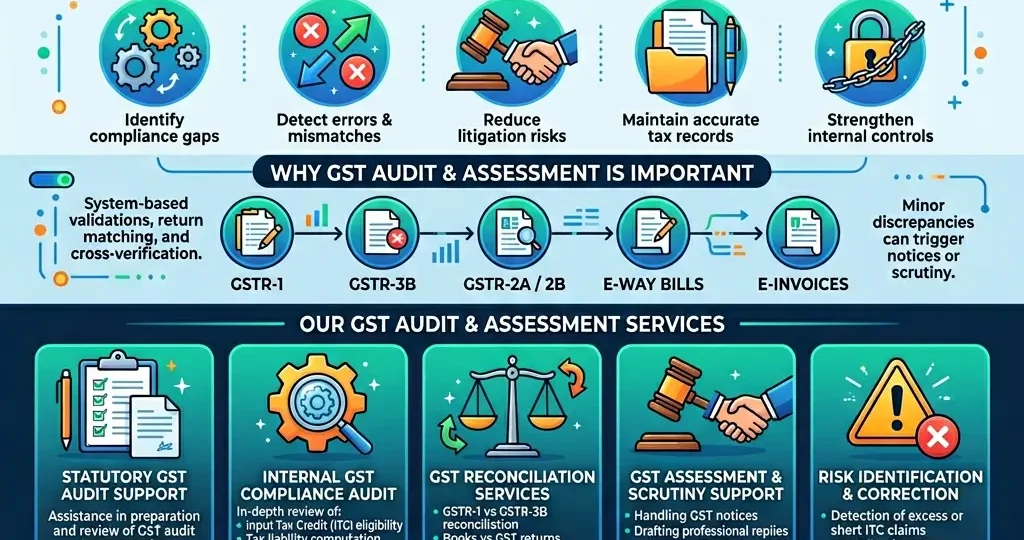
GST Audit & Assessment plays a vital role in ensuring that businesses comply with Goods and Services Tax (GST) laws in India. With increasing regulatory scrutiny, data-driven monitoring, and frequent amendments in GST provisions, businesses face higher risks of notices, penalties, and disputes. A structured and professional GST audit and assessment process helps organizations identify errors, manage risks, and maintain accurate tax records.
Our GST Audit & Assessment services are designed to help businesses comply with GST regulations, minimize tax exposure, and prepare for departmental audits or scrutiny proceedings. We provide end-to-end support covering statutory audits, internal audits, reconciliations, assessments, and representation before GST authorities.
Understanding GST Audit
A GST audit is a systematic examination of a registered taxpayer’s records, returns, invoices, and financial statements to verify:
- Accuracy of tax declared
- Correctness of input tax credit claimed
- Proper classification of goods and services
- Compliance with GST laws and rules
- Timely payment of tax, interest, and penalties
The objective of a GST audit is not only to ensure compliance but also to detect inconsistencies and reduce future litigation risks. A well-conducted GST audit helps businesses identify gaps before tax authorities detect them.
Types of GST Audit
Statutory GST Audit
Statutory GST audit applies to certain categories of taxpayers based on turnover thresholds and government notifications. It involves detailed verification of returns and reconciliation of financial statements with GST filings.
Departmental GST Audit
This audit is conducted by GST officers to examine compliance. Officers may request records, invoices, contracts, and reconciliation statements to verify tax liability.
Internal GST Audit
An internal audit is a voluntary compliance review conducted by professionals to identify errors before notices are issued. It is a proactive approach for risk management.
Special Audit
In specific cases where complexity or revenue risk is high, GST authorities may order a special audit by a nominated professional.
Understanding GST Assessment
GST assessment refers to the process of determining the correct tax liability of a taxpayer. It ensures that tax has been properly calculated, reported, and paid.
Types of GST Assessment
Summary Assessment
Used in urgent cases to protect revenue interest.
Self-Assessment
Taxpayers calculate and declare their tax liability through GST returns.
Provisional Assessment
When valuation or tax rate is uncertain, provisional assessment is permitted subject to later finalization.
Scrutiny Assessment
Returns are examined by GST officers for discrepancies, inconsistencies, or abnormal patterns.
Best Judgment Assessment
Applied when returns are not filed or records are insufficient.
Summary Assessment
Used in urgent cases to protect revenue interest.
Assessment ensures revenue protection for the government and legal certainty for businesses.
GST Returns Relevant for Audit & Assessment
| Return | Purpose | Frequency |
| GSTR-1 | Sales details | Monthly / Quarterly |
| GSTR-3B | Tax payment | Monthly / Quarterly |
| GSTR-9 | Annual return | Yearly |
| GSTR-9C | Reconciliation | Yearly (if applicable) |
Scope of Our GST Audit & Assessment Services
GST Compliance Review
We conduct a comprehensive review of:
- GSTR-1, GSTR-3B, GSTR-9 filings
- E-way bills
- Tax payment records
- ITC eligibility
- Place of supply and valuation
This ensures consistency between financial records and GST returns.
Reconciliation Services
We provide detailed reconciliations of:
- Books of accounts vs GST returns
- GSTR-1 vs GSTR-3B
- GSTR-2B vs ITC claimed
- Annual return vs financial statements
Reconciliation helps identify mismatches that can trigger notices.
Statutory Audit & Certification Support
Our team assists with:
- GST audit preparation
- Compilation of audit documentation
- Preparation of reconciliation statements
- Certification support
- Compliance with statutory timelines
Departmental Audit Assistance
We represent and assist during:
- GST department audits
- Data requests and document submission
- Personal hearings
- Clarification submissions
- Rectification of audit findings
Our role is to ensure lawful and fair assessment.
GST Assessment Proceedings
We handle:
- Scrutiny notices
- Provisional assessment applications
- Best judgment assessment disputes
- Summary assessment representation
- Final order review
Each assessment stage is managed strategically to reduce exposure.
Input Tax Credit (ITC) Verification
We review:
- ITC eligibility
- Blocked credits
- Vendor compliance
- Invoice documentation
- ITC reversals
ITC disputes form the largest risk area in GST audits.
Refund Audit & Assessment Support
We assist in:
- Export refunds
- Inverted duty structure refunds
- Excess tax refunds
- Refund rejections
- Refund scrutiny replies
Litigation Support Arising from Audit
If audit or assessment results in adverse orders, we provide:
- Drafting of replies
- Appeal filing
- Representation before authorities
Strategic dispute resolution
Importance of GST Audit & Assessment for Businesses
Regulatory Compliance
GST audit ensures that businesses meet statutory obligations and avoid violations.
Risk Reduction
Early detection of errors prevents penalties, interest, and litigation.
Financial Accuracy
Accurate tax reporting improves financial discipline and audit readiness.
Business Continuity
Avoiding compliance disruptions protects operational stability.
Legal Safeguard
Well-documented records provide strong defense in assessments.
Ongoing Trends in GST Audit & Assessment
1. Technology-Driven Scrutiny
GST authorities increasingly rely on analytics to identify mismatches in returns and ITC claims. Automated systems flag inconsistencies between supplier and recipient data.
2. Rise in ITC Verification
Greater focus is placed on validating ITC through supplier compliance, invoice matching, and transaction authenticity.
3. System-Generated Notices
Mass issuance of automated notices has increased, often requiring technical reconciliation responses.
4. Retrospective Reviews
Authorities are revisiting earlier years’ returns to identify tax leakage.
5. Refund Scrutiny Intensification
Exporters and inverted duty businesses face detailed verification of refund claims.
6. Shift Toward Preventive Compliance
Businesses increasingly adopt internal audits to avoid disputes.
Our GST Audit & Assessment Process
- Business profile analysis
- Data collection
- Risk mapping
- Reconciliation
- Compliance review
- Audit documentation
- Representation
- Closure and advisory
Who Needs GST Audit & Assessment Services
- Manufacturers
- Traders
- Service providers
- Exporters
- E-commerce sellers
- Startups
- MSMEs
- Corporates
Any GST-registered entity benefits from professional audit support.
Why Choose Our GST Audit & Assessment Services
- Specialized GST expertise
- Strong reconciliation methodology
- End-to-end compliance management
- Audit-ready documentation
- Strategic assessment handling
- Transparent workflow
- Litigation preparedness
Frequently Asked Questions (FAQs)
Not for all businesses. Mandatory audit depends on turnover and regulatory requirements.
GST assessment is the process of determining correct tax liability by taxpayer or tax authorities.
Officers examine returns and ask for clarification on mismatches.
Invoices, returns, bank statements, contracts, ledgers, and e-way bills.
Yes, if documentation or supplier compliance is missing.
Professional representation can challenge or reduce demand.
It varies depending on case complexity and stage.
Yes, due to complexity and legal consequences.
Conclusion
GST Audit & Assessment is a crucial pillar of GST compliance in India. With evolving laws, increasing automation, and heightened scrutiny, businesses must proactively ensure accuracy and transparency in tax reporting. Professional GST audit and assessment services help identify errors early, manage risks, and protect businesses from penalties and disputes.
Our comprehensive GST Audit & Assessment services are designed to support businesses at every stage — from internal compliance review to departmental audit representation and assessment proceedings — ensuring peace of mind and regulatory confidence.
