

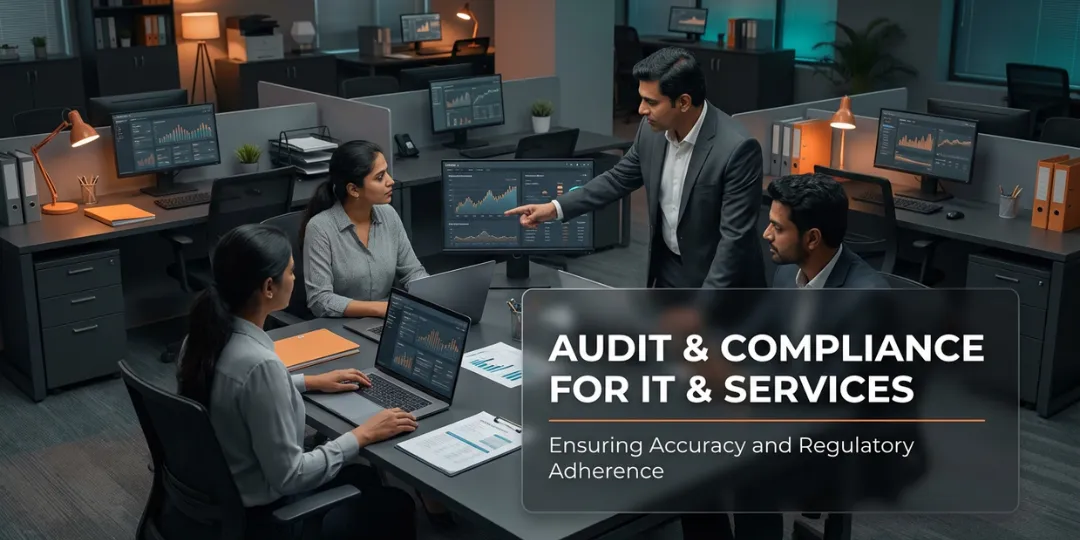
What is Audit & Compliance in IT & Services?
Audit and compliance in IT and services involve systematically examining a company’s financial statements, operational processes, and regulatory adherence to ensure accuracy, reliability, and accountability. Unlike traditional industries, IT and services companies often deal with complex contracts, recurring revenue models, intellectual property, and data-driven transactions, which require specialized auditing approaches.
Compliance refers to meeting statutory and regulatory requirements applicable to the business, including tax laws, corporate governance, IT security standards, and industry-specific regulations. Together, audit and compliance services ensure that IT and service companies maintain financial integrity while adhering to all legal obligations.
Importance of Audit & Compliance for IT & Services
IT and service-based companies face specific risks and challenges that make audit and compliance critical:
Complex Revenue Recognition
IT and service companies often operate on subscription models, service contracts, and project-based billing. Accurate revenue recognition ensures that financial statements reflect the true financial position.
Regulatory Adherence
Compliance with laws such as GST, income tax, service tax, corporate regulations, and industry-specific standards is mandatory. Non-compliance can lead to penalties and reputational damage.
Risk Management
Auditing helps identify operational, financial, and IT-related risks, including cybersecurity threats, contract discrepancies, and misreported revenues.
Investor and Stakeholder Confidence
Accurate audits and compliance reports build trust with investors, clients, and stakeholders, enhancing the company’s credibility in competitive markets.
Improved Operational Efficiency
Audits reveal inefficiencies in processes, enabling companies to streamline operations, reduce costs, and optimize resource utilization.
Preparation for Growth and Funding
For IT and service startups seeking venture capital or bank financing, verified financial statements and compliance reports are crucial for attracting investors.
Key Areas Covered in Audit & Compliance for IT & Services
Professional audit and compliance services for IT and service companies typically cover the following areas:
1. Financial Audit
- Verification of revenue recognition and billing accuracy
- Review of accounts receivable, payable, and cash flow
- Assessment of financial statements for accuracy and completeness
- Identification of errors, misstatements, or fraudulent activities
2. Regulatory Compliance
- GST, income tax, and service tax compliance
- Adherence to corporate and company laws
- Industry-specific regulatory compliance (IT Act, data protection, software licensing)
3. Internal Controls & Risk Assessment
- Evaluation of internal control systems
- Assessment of operational risks, IT system security, and process compliance
- Recommendations for mitigating risks and enhancing operational efficiency
4. IT & Cybersecurity Compliance
- Audit of IT systems and data security protocols
- Compliance with data protection laws and privacy regulations
- Review of software licensing and intellectual property management
5. Contract & Vendor Compliance
- Examination of service contracts, SLAs, and client agreements
- Vendor and third-party compliance checks
- Verification of revenue, expenses, and deliverables under contractual obligations
Benefits of Audit & Compliance Services for IT & Services
Accuracy of Financial Reporting
Ensures that all revenues, expenses, and assets are correctly recorded, providing a true picture of the company’s financial health.
Risk Mitigation
Identifies potential operational, financial, and IT-related risks, allowing proactive measures to prevent losses.
Regulatory Assurance
Maintains compliance with all statutory requirements, reducing the likelihood of fines and legal actions.
Enhanced Decision-Making
Accurate data and compliance reports enable management to make strategic business decisions with confidence.
Investor Confidence
Transparent audits and compliance build trust among investors, clients, and stakeholders, which is crucial for funding and expansion.
Operational Efficiency
Auditing processes highlight inefficiencies, enabling process optimization and cost savings.
Best Practices for IT & Service Companies
Regular Audits
Conduct audits periodically, such as quarterly or annually, to maintain continuous compliance and accurate financial records.
Implement Strong Internal Controls
Develop and maintain robust internal processes for finance, IT security, and operational management.
Leverage Technology
Use accounting and compliance software to automate data recording, reduce errors, and simplify auditing.
Staff Training
Train employees on regulatory updates, compliance requirements, and ethical practices to minimize errors and risks.
Engage Professional Advisors
Hire specialized audit and compliance professionals familiar with the IT and service sector to ensure industry-specific risks are addressed.
Common Challenges in IT & Service Audits
Complex Revenue Streams: Subscription models, milestone-based billing, and recurring service charges require detailed tracking.
Rapid Technological Changes: Frequent updates in software, IT infrastructure, and processes may create compliance gaps.
Data Privacy Concerns: Ensuring compliance with data protection laws and cybersecurity standards is critical.
Global Operations: Companies with international clients or operations must navigate multiple regulatory frameworks.
Professional audit and compliance services help mitigate these challenges by providing specialized expertise and structured processes.
Conclusion
Audit and compliance are vital for IT and service companies to maintain financial accuracy, operational transparency, and regulatory adherence. Beyond meeting statutory requirements, these services help businesses manage risks, optimize processes, and build investor confidence. Engaging professional auditors and compliance experts allows IT and service companies to focus on innovation and growth while ensuring that financial and operational standards are met.
For IT and service-based businesses aiming for sustainable growth, strong internal controls, and regulatory compliance, audit and compliance services are essential pillars of business success.
Audits are typically conducted annually, but companies with high transaction volumes or regulatory requirements may opt for quarterly or semi-annual audits.
